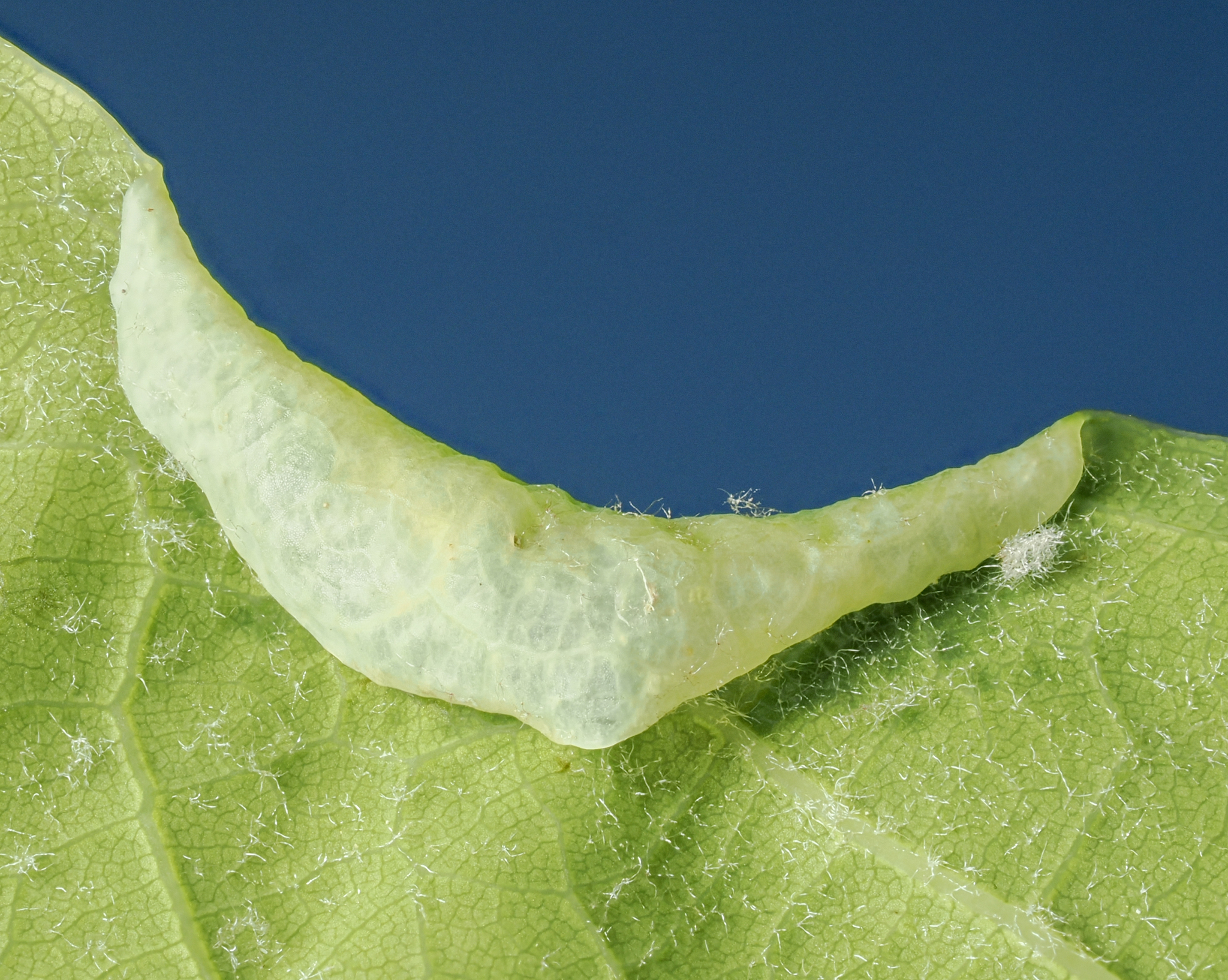
Cecidomyia (?) foliora n. sp.
This insect was discovered by Mr. W. V. Tower, in July, 1905, working on the leaves of a black oak. He began observation on its life history but was called away and the work was taken up by Mr. H. M. Russell. Mr. Russell had practically finished, except for describing the adult, when he left to take a position with the U. S. Department of Agriculture and the subject was placed in my hands to complete. In addition to verifying Mr. Russell's observations, I have described the adult, which Mr. E. P. Felt kindly determined as a new species. The gall which it forms has been described by Osten Sacken as C. erubescens.* This species of gallfly is very abundant on a black oak (Quercus coccinae var. tinctoria group [velutina]) growing near the President's house on the college grounds. This oak is in a small clump of red oaks, none of which have become infested; this seems to indicate that this Cecidomyia will feed only on black oak, as the infested tree harbors many thousands of the larvae and under its branches, the adults are found in swarms. Every leaf is infested, by from one to over one hundred, as high up as one can climb, certainly within ten feet of the top ; but the infestation at the highest point is not as extensive as that of the lower limbs.
LIFE HISTORY. Adult. The adult insect emerges from the ground from May i to 20, and all have disappeared by June I. In the spring of 1908, the author caught five adults May 4, and by May in the insects were found under the tree in thousands, being so numerous that it was only necessary to sweep an open cyanide jar over the top of and through the grass to obtain all the specimens desired. The adults appear just as the leaves begin to unfold. For a time, after emerging, large numbers will be found in the early morning and on wet days especially, under the tree, but as it gets warmer and the dew dries off, they rise among the branches. They have a feeble flight, however, and do not fly out beyond the borders of the tree. When the leaves are one to two inches long, the females fly to the leaves and begin to lay their eggs, for the most part on the under side.
Eggs. The eggs are laid without any regular order, attached to the leaf by the posterior pole and placed diagonally to the plane of the leaf surface. The egg is minute, appearing to the eye like a reddish protuberance. Under the microscope it is seen to be almost perfectly oval, .27 mm. long and .09 mm. wide. The surface is smooth and the egg shell transparent, the reddish color more intense at one end, being due to the larva inside. Most of the eggs are scattered irregularly between the veins on the lower surface, but a few are generally laid, apparently by chance, on the upper side. From fifty leaves, an average of seventy eggs was obtained for each, with not over six on the upper side, but the total number varied from forty to one hundred and twenty. On one leaf, an inch and three-quarters of in inch wide, there were two hundred and eighty-one eggs on the lower saiface and one hundred and seventy-five on the upper. This, however, is an exceptional case.
Larva. The larva hatches in from four to six days, the time varying with the weather. The body is pale orange, the head a shade darker. Length .27 mm.; width .10 mm. They go at once to the edge of the leaf, or to any hole in it, and begin to feed on the upper surface. After about four days of this feeding, the edge beings to curl over on to the upper surface, forming a roll, the upper side of which becomes more or less reddish. Within this roll, the larva continues to feed, extending the roll as it grows. Occasionally, a young larva feeds for a time in a circle on the exposed surface of the leaf, causing it to become reddish and wrinkled. By May 22, nearly all the leaves near the ground show the rolls, which in some cases, nearly encircle the leaf, while in others, they may be about one-quarter of an inch long. In one roll, an inch long, twenty-five larvae were found ; while in others, only a few were present. As a rule, the longer the roll, the fewer insects they contain relatively. The insects remain in the larval stage through the summer, becoming full grown by the last of September or first of October, when all but those parasitized descend into the ground and pupate to pass the winter. In exceptional cases, perfect larvae are not able to escape from the roll in the fall, and so pass the winter in the gall, emerging at the usual time in the spring through cracks or punctures in the drier rolls.
[Figure caption]
-
Lower side of leaf showing galls, half natural size. [The galls within the leaf, based on the passage, apparently represent galls formed around the margins of herbivore damage?]