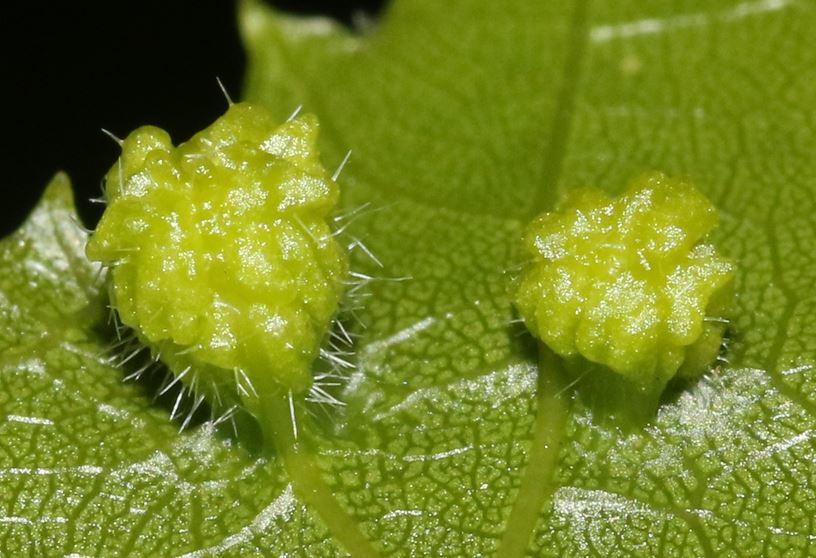
Daktulosphaira vitifoliae (Fitch)
An investigation was undertaken to determine the correct name of the grape phylloxeran. This action was desirable because more than one spelling of the specific name and more than one name combination are in current use for the species. The inquiry revealed that Daktulosphaira vitifoliae (Fitch) is the oldest available name for the species.
The grape phylloxeran, a native of North America, has been of economic importance since its accidental introduction into Europe and other viticultural centers of the world in the last century. At that time it virtually destroyed the grape industry in severely infested areas. Although the insect is no longer seriously destructive in some areas, it is injurious in others, and its symbionts, its biology, and its control are being studied. Federov (1959) discussed the injuriousness of the phylloxeran and stressed the need for its adequate control. Shaposhnikov (1967) stated, "This is the most serious pest of grapevine." Maillet (1957) gave an ex- tensive discussion, review, and bibliography of the species. Literature on the biology, morphology, ravages, and con- trol of vitifoliae is voluminous.
The names, spellings, accreditation of author names and the earliest noted publication of names of the grape phylloxeran are as follows:
[many synonyms are listed; see link or list above]
Although vastatrix was used extensively for several years after publication, it as well as the other specific names listed above have long been recognized as synonyms of vitifoliae .
Fitch (1855: 862, 1855: 158, 1857: 397) invariably called the insect whose galls he observed on grape leaves in New York State "the grape leaf louse (Pemphigus Vitifoliae)." Signoret (1869: 556, 565) spelled the name vitifolii. Planchon and Lichtenstein (1871: 5) stated that vitifoliae was incorrect and should be rectified to vitis folii. Riley (1871: 95) rejected their opinion, stating "... though "folii" would of course be more grammatically correct, one would suppose the Doctor [Fitch] had some reason for his conduct." Thomas (1879: 158) also indicated that the spelling should be vitis-folii or vitifolii, but he approved vitifoliae, and wrote "... names with the termination have been too long received for this to be a valid objection in this case." Grassi (1912: 10) suggested vitisfoliae as well as vitisfolii and vitifolii. All spellings except vitisfoliae have been used, with Europeans tending to use vitifolii and Americans usually using vitifoliae.
Article 32(a)(ii) of the International Code of Zoological Nomenclature states "... incorrect transliteration, improper latinization, and use of an inappropriate connecting vowel are not to be considered inadvertent errors. . ." Thus according to the Code, vitifoliae is the legal spelling of the name.
The generic name with which vitifoliae has been combined has varied. Fitch (1855, 1857) always, and Walsh (1863) originally, placed vitifoliae in aphid genera. Later Walsh (1866: 111, 1867: 284) indicated that Fitch erred in considering the insect an aphid, did not mention his own 1863 assignment, and stated (1867: 284) that the insect was "... a true bark-louse belonging to the Coccus family" and that it ". . . must become the type of a new and very aberrant genus."
Shimer (1866: 290) studied "Pemphigus vitifolia" stating, "The result of these investigations developes a new genus, of a new family, in the third division Monomera of the Homoptera, for this and another insect (also one of Mr. Walsh's coccus) found in a small subglobular gall on the leaf of the Pignut Hickory; and probably, some two or three other insects that I have seen. These may possibly comprehend more than one genus when more thoroughly studied."
Shimer (1866: 290) then described but did not name the genus, indicated that vitifoliae and possibly another species belonged in it, and stated, "The insect inhabiting the small gall on the Pignut Hickory (Caoja[!] glabra) and which doubtless is identical with that referred to by Mr. Walsh, P.E., 111, although the galls are mostly all larger than a "cabbage seed," I believed after careful examination of the female and larva to belong to the same genus as the "grape leaf louse," and suggested for it the species name of globosum."
The reference to Walsh and the size of the gall were the only statements that could be construed as a description of globosum. Walsh (1866: 111-112) de- scribed the gall referred to by Shimer as ". . . an undescribed gall the size of a cabbage-seed on the leaves of the Pignut Hickory (Carya glabra)." This presumably meets the requirements of Article 16(a) (viii) of the Code as an indication of a specific name, but it does not meet the requirements of Article 1 1(g) (ii) because globosum was not combined with a generic name.
Shimer (1866: 365) referred to his earlier (1866: 290) article, named and briefly described the new genus Dak- tulosphaira and placed a single species, Pemphigus vitifoliae Fitch, in it but (p. 365) did not mention globosum. And he did not give the derivation of his new generic name which is, according to Steyskal (1974), a literal translation of the Greek.
The following year Shimer (1867: 2) described "Dactylosphaera. New genus" and gave the Greek from which the name was derived. This spelling, also according to Steyskal (1974), is a classical Latin transcription of the name. Shimer (1867: 2-11) also described "Dactylosphaera globosum, n. sp." placing that species before vitifoliae which he assigned to Dactylosphaera with a question. His only mention of his former articles was to state that in 1866 he had called vitifoliae the "Grape leaf louse." He (1867: 5-8) redescribed vitifoliae and stated "In case, however, the characters given above should be sufficient to separate, generically, vitifoliae from D. globosum, I would propose the generic name of Viteus for the former."
Walsh (1867: 24-28) immediately ac- cepted Dactylosphaera vitifoliae as the correct name for the grape leaf louse, while Riley (1871: 84) used Phylloxera vitifoliae, the name that was used much more frequently than Daktulosphaira vitifoliae or Dactylosphaera vitifoliae for many years.
Because Shimer' s original descriptions of globosum and Daktulosphaira were published in a farm journal of uncertain distribution, and because the articles were not cited in his 1867 publication where he described globosum and Dactylosphaera as new, the 1866 articles presumably were overlooked or ignored by some workers while others apparently assumed that Dactylosphaera was a correction of Daktulosphaira and that the name should date from 1867. Later Shimer (1869: 386-398) described or redescribed several phylloxeran species that lived in galls on hickories, placing them in Dactylosphaera. He (p. 392- 393) again mentioned D. globosum as a species living on hickories but did not use the name vitifoliae.
Pergande (1904: 236b-238) treated globosum as Phylloxera globosum , citing Shimer' s 1867 publication. Although Pergande did not discuss the status of Dactylosphaera, he presumably con- sidered the name a synonym of Phyl- loxera, because he placed in the latter genus the various species included in Dactylosphaera by Shimer in 1869. Pergande (p. 213) mentioned vitifoliae only in a quotation from Shimer 1867 and did not refer to Shimer' s 1866 articles.
Wilson (1910: 150, 155) listed Dactylosphaera Shimer 1867 with globosum the type, Daktulosphaira Shimer 1866 with vitifoliae the type, and Viteus Shimer 1867 also with vitifoliae the type. Borner (1930: 159, 162, 193) synonymized Viteus with Daktulosphaira, but later (1952: 212, 227) recognized as valid genera, Dactylosphaera with globosum as its type-species and Viteus with vitifoliae as its type-species, stating that Daktulosphaira (1866) with vitifoliae as its type was an error for Dactylosphaera (1867).
Prior to 1952, both while and after synonymous names were in use, Phylloxera vitifoliae was the most commonly used name for the species. Dactylosphaera vitifoliae appeared occasionally, and Daktulosphaira vitifoliae and Viteus vitifoliae were rarely cited. Since 1952 non- Americans have tended to use Dactylosphaera vitifoliae (or vitifolii) or Viteus vitifoliae (or vitifolii) while Americans, without critical consideration of the insect's name or relationships, have continued the use of Phylloxera vitifoliae.
Daktulosphaira falls under Article 32(a)(ii) of the Code because, in the original publication, there is no "clear evidence of an inadvertent error, such as a lapsus calami, or a copyist's or printer's error" and "(incorrect trans- literation, improper latinization. . . . are not to be considered inadvertent errors)." Since vitifoliae was the only species included in the genus, Daktulosphaira vitifoliae (Fitch) is the correct name for the grape phylloxeran, and Viteus is a synonym of the older generic name. Because there has not been unanimous use of one name in recent years, common usage would not be seri- ously disrupted by using Daktulosphaira vitifoliae, the name that merits general acceptance.
The identity of globosa is uncertain. Types of the species are not known to exist, and morphological characteristics of the insects have not been adequately diagnosed. Recognition of the species has depended primarily on the appearance of its galls which Shimer (1869: 392-393) indicated he believed he had confused with galls of Dactylosphaera caryae semen Walsh in his 1867 description of globosum. Pergande (1904: 213, 237) affirmed this opinion and redescribed and illustrated the galls of the two species. Shimer (1869: 393) also indicated that the trees on which he observed globosum and caryaesemen in 1867 were Carya amara instead of Carya glabra as he had previously reported. Pergande (1904: 213) noted galls of caryaesemen on Carya glabra in the Mississippi River Valley but did not state whether galls of glob- osum were present. I believe there may be some uncertainty concerning the true host(s) of globosa.
Perhaps it would be possible to collect galls and specimens of globosa and, after critical field and laboratory studies, determine the identity of the species. But until such studies are made, the status of globosa and Dactylosphaera will remain unclear.
Daktulosphaira vitifoliae differs morphologically and biologically from Phylloxera quercus Boyer de Fonscolombe (1834: 223-224), the type-species of Phylloxera Boyer de Fonscolombe (1834: 222), and the two are not con- generic. D. vitifoliae lacks prominent, tuberculate dorsal and marginal processes and lives in galls on the leaves and in cavities of swellings on the roots of Vitis. P. quercus has strongly developed, elongate processes on the dorsum and margin of the body in apterae and on the head and thorax in alatae. This species lives on the lower surface of the leaves of oak and does not cause galls.