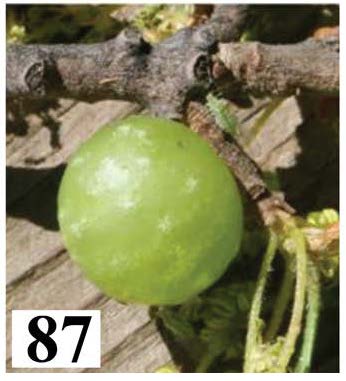
Cynips echinus bisexual form
Dryophanta lobata
Andricus ribes
Gall: Spherical, berry-like, very succulent, pale green and more or less translucent when fresh, bright red when very young; the surface smooth or, in some varieties, pebbled and indefinitely marked with low ridges which bear soft, projecting points. The galls 4 to 7 mm. in diameter, shrivelling greatly upon drying, then becoming blackened; when dried upon the twig they become more or less obconical in shape, remaining lighter straw-brown in color. The wall of the gall moderately thin, thinnest apically; entirely hollow in- side, without a distinct larval cell. Attached very insecurely by a single, slightly elongated point, on the twigs (bud galls) of probably all the oaks on which the agamic generation occurs; definitely known from only Quercus lobata, Q. Douglasii, and Q. durata.
RANGE .—California, Shasta County to the Mexican border, probably in Lower California.
The bisexual forms of echinus, on the other hand, are known from hardly more than a half dozen recent collections, representing, however, four of the six known varieties of the species. These bisexual galls are probably not rare, but they are small, inconspicuously green in color, and so ephemeral that the chances of their collection are much reduced. They are bud galls that appear with the bursting of the leaf buds the first thing in the spring; they reach full size within a few days, and are then so loosely attached to the young, devel- oping stems that they fall to the ground in a heavy wind or at the slightest touch. The larval insects reach full size rap- idly and, transforming into adults, emerge within perhaps three weeks after the galls first appear. Emergence thus varies with the season, latitude, and altitude, the limits of our scant records being March 23 further south (at Three Rivers for form vibes) to May 13 further north (at Kelsey- ville for form atrata ) . Most of the emergence is probably in April. The males are not rare in our collections and they are probably produced in equal abundance with the females. Ovi- position has not been observed, but it must be in the veins of the then young but unfolded leaves, for the agamic galls appear within a month and a half to two months of that time. The bisexual galls shrivel very greatly when collected and dried, and decay very rapidly when moist, the latter being the explanation of our complete failure to find them except in the short season before the maturity of the insect.
The insects and the galls of the bisexual and agamic forms here described have not hitherto been recognized as successive generations, for they are superficially quite distinct. They are not yet connected by the experimental data to which our conclusions must always be subject; but a closer examination shows so many points of similarity and so much confirmatory host, distribution, and life history data that we may be justified in our present interpretation.
In the first place, the bisexual insects clearly belong to the genus Cynips and to the subgenus Antron.
They differ no more from the agamic forms than the bi-sexual forms of European Cynips differ from their experimentally connected agamic forms.
There are only three species recognized among the agamic forms of Antron, and the present bisexual forms appear to be connected with the agamic echinus rather than with teres or guadaloupensis, for the following reasons: They have the mesonotum reticulated; they have blotched but not spotted wings; there is another bisexual insect (Beutenmtiller’s pulchella) which shows the spotted wings of the agamic teres.
The present bisexual forms are represented by varieties on Q. lobata , Q. Douglasii, and Q. dumosa, on all of which hosts we find the agamic echinus but not teres or guadaloupensis ; teres is unknown from Q. Douglasii on which the agamic echinus is common. The bisexual form is represented in the Central Valleys of California, an area in which echinus is common but teres un- known. The bisexual galls are similar to the galls of the agamic echinus in being fundamentally spherical with short, blunt, projections; and the bisexual gall is most nearly spherical and most nearly spineless on the host that bears the agamic echinus galls of this nature (variety schulthessae on Q. durata).
There is nothing in the structural, host, and distributional data which would preclude the connection of these bisexual forms with echinus, while there would be the several inconsistencies noted above in connecting the forms with teres.
In spite of the difficulty of collecting the spring galls, they are known to represent four varieties and therefore probably belong to a species that has at least as many common agamic forms known. The agamic echinus again qualifies on this count.
This species contributes materially to our comparison of morphologic and physiologic data in taxonomy. The agamic insects of the several varieties are all similar, and in several cases practically identical; the bisexual insects are as nearly identical; the bisexual galls are indistinguishable in three varieties, but the agamic galls are so distinct that most workers would accept them as the work of different species. Were we dealing with a group of insects in which we had no such physiologic data as the galls, it is quite certain that no one would arrive at our present classification, and the accompanying host and distributional data would then be largely meaningless. How much insect taxonomy is inadequate and misleading is a matter for serious contemplation.
That the differences in these agamic galls are not due to the qualities of the various oaks on which they occur, is proved by the occurrence of three types of galls, the work of three different varieties of echinus, on Quercus dumosa in Southern California.
Attention should be drawn to the peculiar, crystalline materials of which all these agamic galls are built. Between the thin epidermis and the wall of the larval cell there are solid masses of microscopic, deformed crystals intermingled with a few fibers of similar material. This substance is commonly reputed to be gallic acid (as in Fullaway 1911), and if this is so, these galls must have a very high percentage of the material. It would be interesting to know how the gall in its development segregates or stimulates the manufacture of this substance in the normal oak leaf. When the galls are moist (whether young or old) they are as soft as rubber. When dried, they quickly become as hard to cut with a knife or drill as tho they were made of so much compacted, ground glass. In order to mount such specimens on insect pins for preservation in our collections we soak the galls in water for a few hours, or place them out-of-doors in a damp location for a few days, after which they are readily penetrated by the pins.
In addition to the six varieties now known in this species, there are probably two or three additional varieties still to be described from California, but probably none to be expected elsewhere in this country.
[Kinsey goes on to describe 4 varieties of the bisexual form of this species; see paper for details]