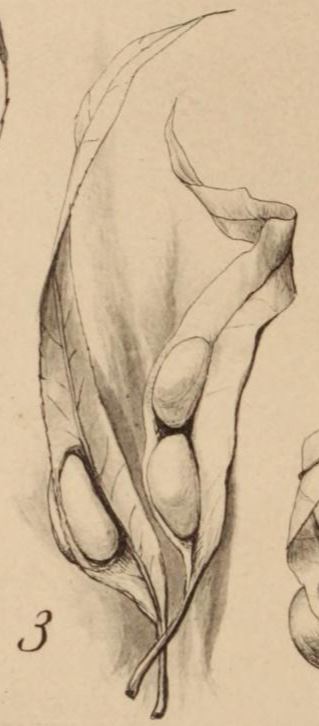
Pontania desmodioides Walsh.
"On Salix humilis. A smooth, flattish, fleshy, sessile , yellowish- green monothalamous gall of a semicircular outline, the chord of the semicircle adjoining the midrib of a leaf; its general shape like the seed of a Desmodium or like the so-called "quarter" of an orange, the thin inside edge of the "quarter" closely hugging the midrib of the leaf, and the robust outer surface not biangulated but rounded off. No rosy cheek. The volume of the gall is generally about equally divided between the upper and lower sides of the leaf but sometimes the lower portion is rather the larger. Usually there is but a single gall on a single leaf, but occasionally there are two of them, either on the same side or on opposite sides of the midrib." — Length .23 to .50 inch Walsh.
When mature this gall shows in cross section a cavity surrounded by a peripheral layer of little differentiated tissue. The epidermis has given rise to a very thick cuticle that is not present in the normal leaf. The bundle of the midrib has been injured only slightly by the ovipositor of the producer. The vascular strands given off from it almost encircle the gall along a line half way in from the epidermis.
A stage of the gall so young that the larva was unhatched shows the gall tissue to have been produced by cell division in the upper epidermis, the spongy parenchyma and the palisade parenchyma of the normal leaf (Fig. 80). At the thickest part of the gall, when it is in this stage, the upper epidermis has produced four layers of cells, the spongy and palisade parenchyma seven layers each. The lower epidermis has not divided as yet, and probably takes no part in the production of the gall. The abnormal cells from the palisade parenchyma show clearly their origin by their arrangement in rows at right angles to the surface of the leaf. The cells produced by the spongy parenchyma, on the other hand, are not regularly placed but include air spaces. The result is that the abnormal tissue in this case also resembles the normal tissue from which it is derived.
This stage of the gall shows that the cavity present in the mature gall has arisen between the tissue produced by the spongy and that derived from the palisade parenchyma of the normal leaf.
Read more...
License:
Public Domain / CC0