Mordwilkoja vagabunda Walsh.
Byrsocrypta vagabunda
Pemphigus vagabundus
Pemphigus oestlundi n. sp., Cockerell, Ent. News, p. 34, 1906.
Mordivilkoja oestlundi
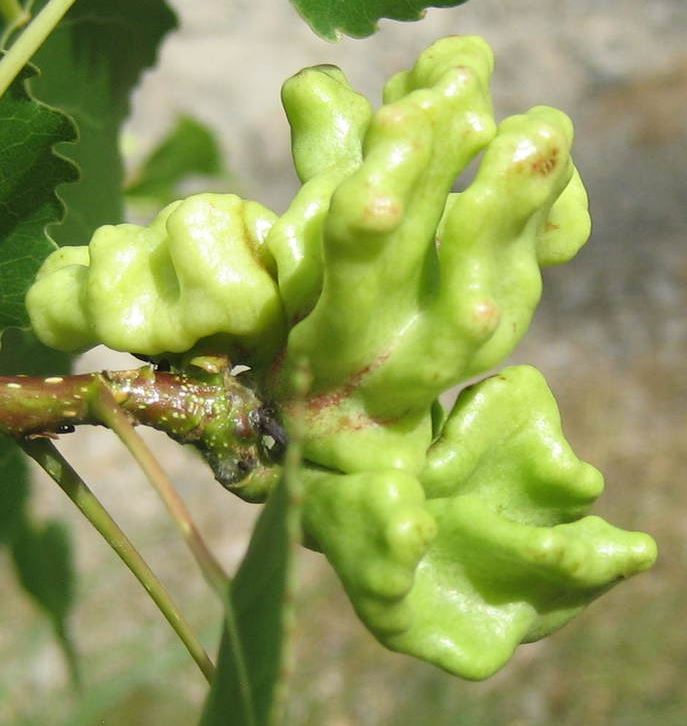
The galls of this louse at the terminal buds of cotton- wood twigs have occurred in greater or less abundance in at least one limited locality near Fort Collins, Colorado, for the past fifteen or more years. The section referred to is mostly rather low, moist land, along the course of an irrigating ditch and near the river. It seems strange that the galls should not have become more generally distributed unless the alternate host is largely limited to the area mentioned. I am assuming that there is an alternate host for the reason that the lice all become winged and leave the galls rather early in the summer. Most of them are gone by August 1st here. The Galls, Figures IS, 19 and 20. When growing, the galls are as green in color as the Cottonwood leaves, and are, in fact, a transformed leaf in each case. On the inside of the green gall the main veins of the leaf are very prominent. Apparently these galls differ from others produced by Aphids by not having any opening to the exterior during their growth, but Mr. L. C. Bragg has discovered a small brown scale (Figure IS A, and 20, b) at the base of the gall, which seems to be the apex of a folded leaf, beneath which is an opening to the interior and through which the blade of a pen- knife may be passed without cutting any tissue. This opening is so narrow that the lice do not escape by it. About the time that fully matured winged lice are developed in a gall (about July 10th to loth, at Fort Collins), little star-shaped mouths (Figures IS and 19, o) appear at the apices of the more prominent lobes thru which the alate lice escape. Many of them appear on a single gall as shown in Figure 18. The galls nearly always are from terminal buds, and whether one or more of the leaves form a single gall I have no certain knowledge, but apparently it is one in each case. Large galls measure as much as SO to 95 mm. in greatest diameter, and about 50 to 60 in the greatest thickness.
*Professor Oestlund, in his Aphididae of Minnesota, p. 22, states that Walsh's vagabundus is evidently something different from the louse that has since been known to be associated with the coxcomb gall. To be sure, September is late to take the migrants from these galls, and the measurements given by Walsh are too large for this species. But he evidently had a louse belonging to the Genus Pemphigus, as then understood, and in the Walsh-Riley paper published in Vol. I, of American Etomologist, page 107, the vagabond gall was figured, and both the winged lice and the apterous stem mothers from the galls mentioned. As Walsh at that time considered the winged lice from these galls the same as what he had described as B. vagabunda, it seems to me best to abide by his identification of his own species, and especially as we do not know any other species to which to refer his original description, which is quite inadequate for its identification anyway. I am therefore retaining the name vagabunda.