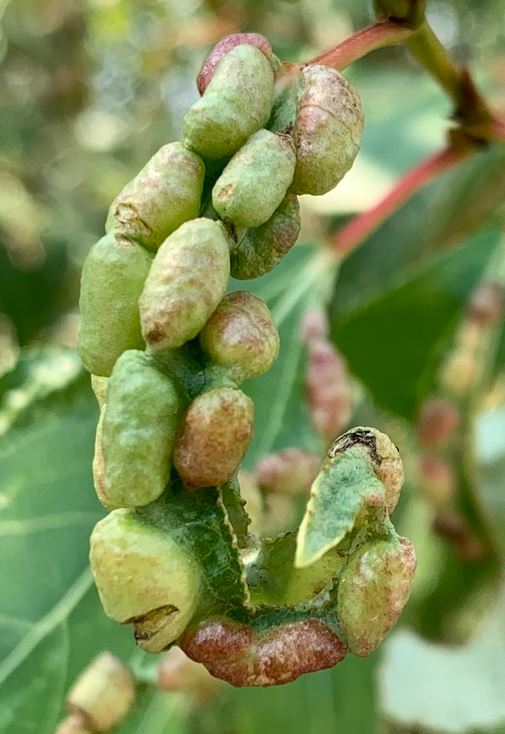
Thecabius populimonilis
Detachable: Integral
Color: pink, red, green
Texture: hairless
Abundance:
Shape: cluster
Season: Spring, Summer
Alignment: erect
Walls: thin, slit
Location: upper leaf, on leaf veins, between leaf veins
Form: pocket
Cells: monothalamous
Possible Range:
Not an occurrence map: this shows where this gall's hosts grow. In most cases the
gall has not been documented throughout this area.
Loading map...
Further Information (7)
Aphids on the world's plants
- Roger Blackman, Victor Eastop
(2013)
License: All Rights Reserved
Aphids of the Rocky Mountain region
- Miriam Palmer
(1952)
License: All Rights Reserved
Common insect and mite galls of the Pacific Northwest
- Hiram Larew, Joseph Capizzi
(1983)
License: All Rights Reserved
Gall Aphids on Poplar in Alberta: I. Descriptions of Galls and Distributions of Aphids
- AM Harper
(1959)
License: All Rights Reserved
Gall-inducing aphids and mites associated with the hybrid complex of cottonwoods, Populus spp. (Salicaceae), on Canada’s grasslands
- Kevin Floate
(2010)
License: All Rights Reserved
Plant Galls of the Western United States
- Russo, Ronald A.
(2021)
License: All Rights Reserved
The tribe Pemphigini (Aphididae) in Utah
- Asa Maxson, George Knowlton
(1929)
License: All Rights Reserved
See Also:




Created Feb 4, 2026 1:47 PM UTC
•
Last updated Feb 4, 2026 1:47 PM UTC