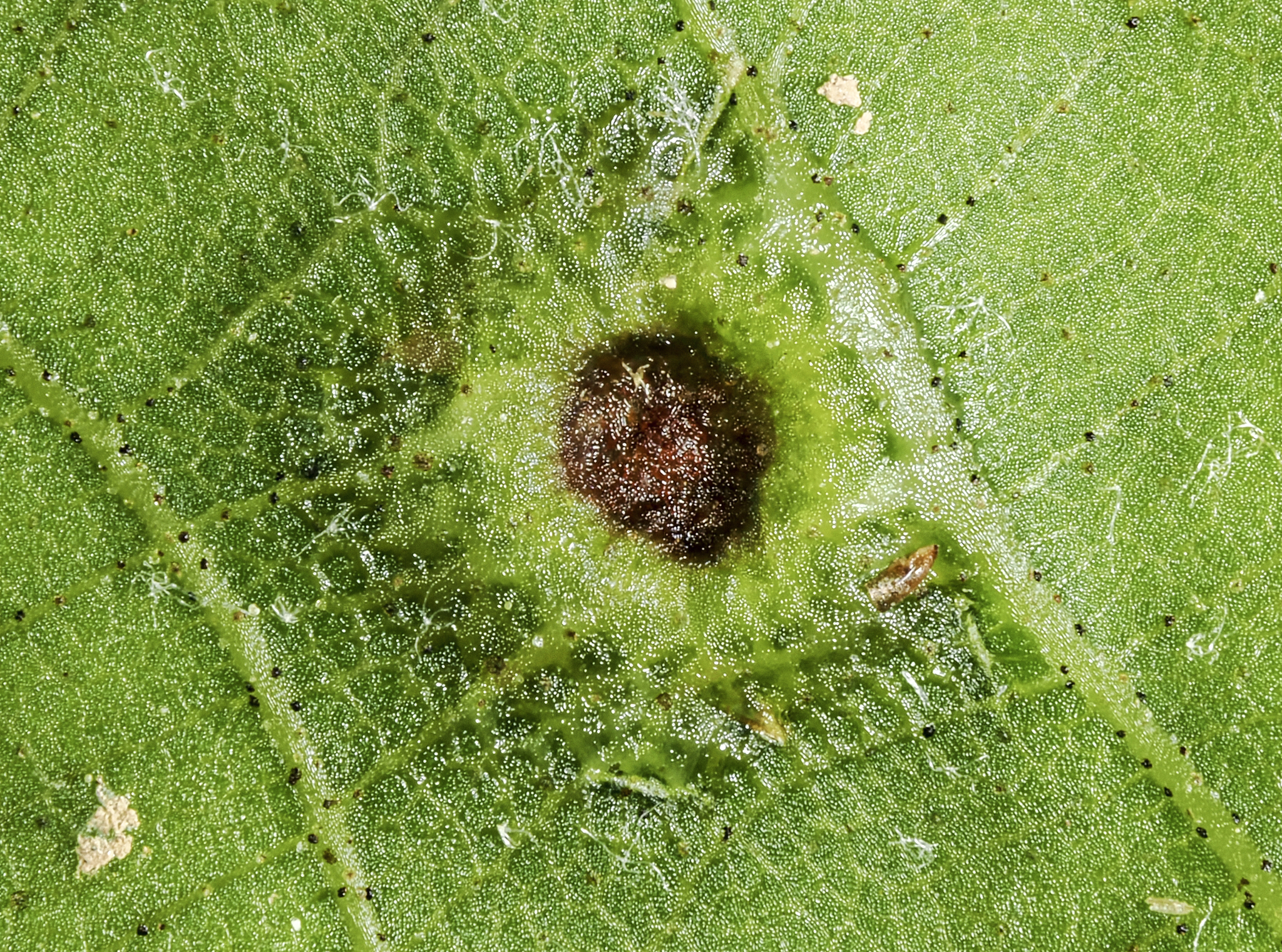
Phylloxera foveola Pergande, n. sp.
The gall of this beautiful species is evidently closely related to and may possibly be identical with Ph. foveata Shimer, but considering the number of closely allied species in which the galls resemble each other more or less closely, and the fact that the inmates of his galls were winged and plentiful by the 20th of June at Mt. Carroll, IL., whereas the galls of foveola are nearly deserted by the 1st of June, near Washington, induce me to consider the two forms as specifically different.
I have found this gall during the latter part of May upon Hicoria glabra in the vicinity of a small creek between Arlington, Va., and the Potomac River. Most of the galls contained, as early as May 23rd, numbers of the winged form. These galls grew either singly or as many as forty upon a single leaf when they become at times confluent, each retaining, however, its char- acter and individual cell intact. On some of the trees they were much more numerous, completely covering some of the leaves. The diameter of the galls ranges more or less between 3-5 mm hor- izontally and between 1-3 mm vertically. They are as a rule very convex and more prominent above than beneath, with a rather deep dimple or depression at the centre, which depression occasionally reaches as far down as to the opposite side of the gall; its basal circumference forms either a depressed or elevated ring. Beneath they are but slightly convex, often sunken below the plane of the leaf, with the centre depressed and bearing a very short, somewhat conical nipple, which is tightly closed and densely covered on the inside with a pale pubescence in the younger galls, whereas in the older or mature galls the nipple splits into 4-8, or rarely more, short and rather flat recurved bracts, which leave a round or slightly oval orifice between them.
In the largest and perfectly developed galls the upper side is either of a delicate pale red with the dimple darker and its basal circumference yellowish-green ; or entirely yellowish-green with only the dimple of a beautiful pink color. Beneath they are uniformly yellowish-green, often with a faint reddish tinge, especially toward the nipple. On the other trees, most densely covered by them, they were less beautiful, with less red and a shallower dimple. The walls are very thin and paper-like and readily collapse when old. All galls are perfectly smooth on both sides.